Why a light coat can cost more to send abroad than heavy jeans
Two numbers decide the price of an international parcel: what it weighs and how much room it takes. This page explains both, then goes through the packaging choices that move them most for buyers outside China.
Actual weight, and what adds to it after you order
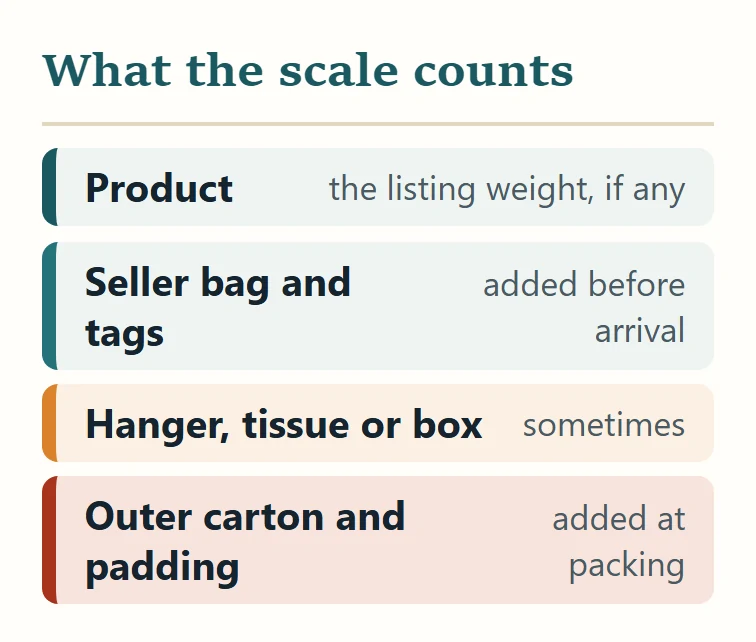
The weight on a listing, when there is one, is usually the product alone. By the time it reaches the warehouse it has gained the seller’s plastic bag, a swing tag, sometimes a hanger, tissue paper or a printed gift box. When the agent packs your parcel it adds an outer carton, tape and padding. None of that is wasteful, but all of it is weighed.
That is why the weight recorded at the warehouse beats any figure from the listing. It is also why parcels made of many small items weigh more than the sum of the products: each one brings its own wrapping.
Ask yourself which extras you actually want at home. A hanger has no use in a suitcase; a dust bag for a leather bag probably does.
Bulk-based weight in one line of arithmetic
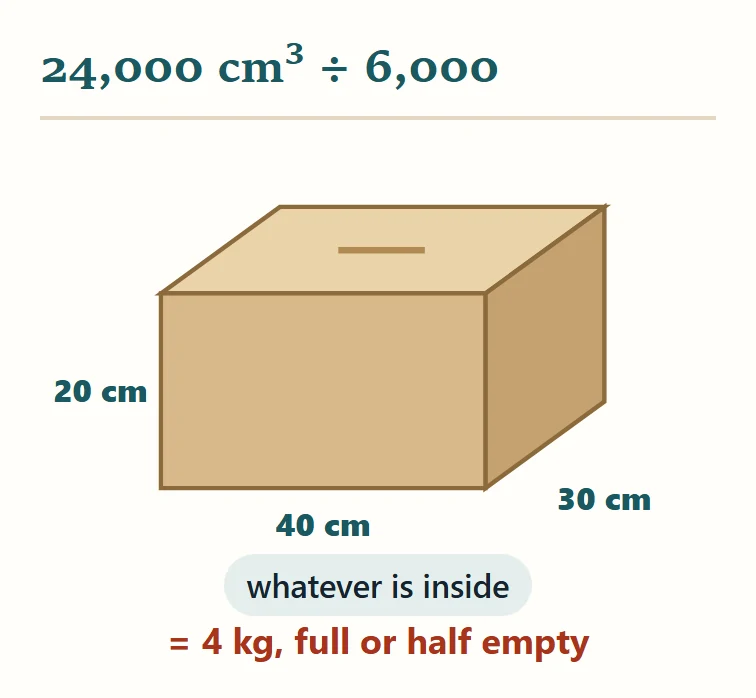
Aircraft and vans fill up by space as well as by weight, so lines charge for bulk. They multiply the carton’s length, width and height in centimetres and divide by a fixed number called the divisor. A 40 by 30 by 20 cm box is 24,000 cubic centimetres; divided by 6,000 that is 4 kg, whatever is inside.
The line then charges the larger of that figure and the real weight. Dense parcels such as jeans and belts are charged by the scale. Airy parcels, padded coats and boxed trainers are charged by the carton.
Each line prints its own divisor, and some postal services charge by weight alone. Read the line terms rather than assuming, and try your own figures in the box planner.
Shoeboxes, gift boxes and the stuffing inside bags
Packaging that protects a product also takes space, and the trade is different for each kind of item. A shoebox keeps trainers from being crushed and keeps their shape, but it can easily double the volume a pair needs. Watches, belts and perfume often arrive in rigid presentation boxes. Structured handbags come filled with paper.
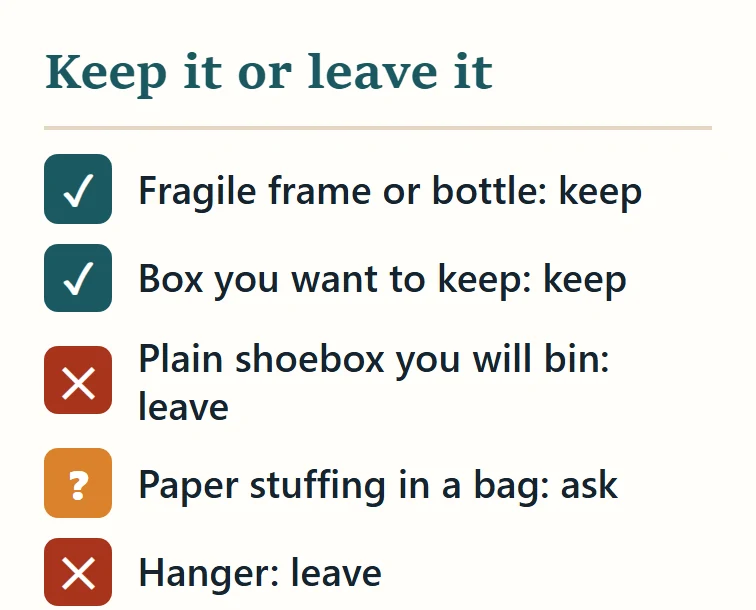
Most agents will remove boxes or stuffing on request before packing; ask CNFans support what it offers and whether it charges, because those service details were never captured from its site. Then decide item by item: keep the box when it protects something fragile or you want it, drop it when it is only cardboard.
Soft goods that squash and goods that will not
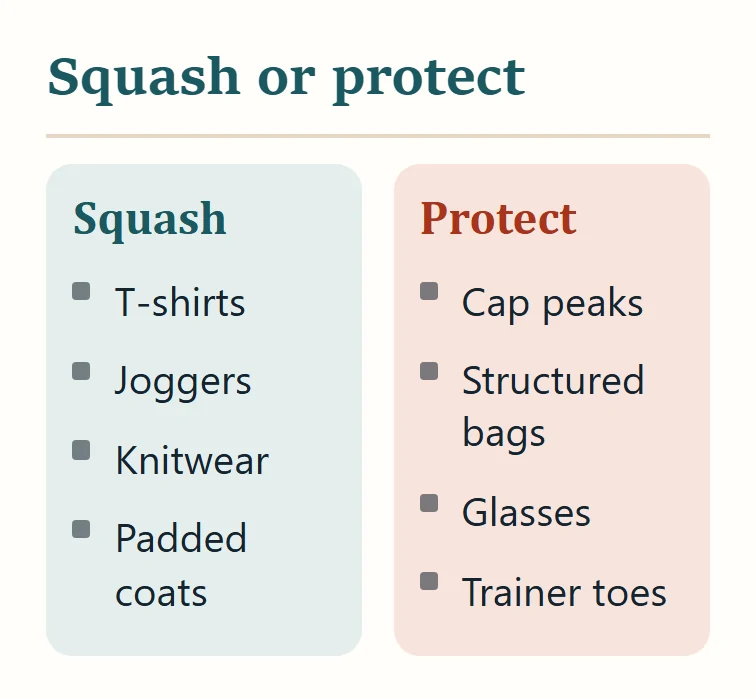
Clothing forgives tight packing. T-shirts, joggers and knitwear fold small, and a padded jacket can be pressed flat or rolled, sometimes into a vacuum bag if the warehouse offers one. That is the cheapest way to shrink a bulky parcel. Down-filled coats recover their loft after a few hours out of the bag.
Some things should not be squashed. Cap peaks crease, structured bags dent, glasses frames bend and trainers lose their toe shape. Group those in the middle of the carton with soft items around them, and accept that they will take a little more room.
Browsing coats and jackets? Look for listings that mention a packable or lightly padded design if you care about the shipping bill.
Cells, liquids, powders and magnets in a parcel
International lines sort goods into what they carry freely, what they carry under conditions and what they refuse. Items with batteries, liquids such as perfume, powders and strong magnets are the usual groups that need a closer look. Some lines take them with a note at booking; others do not take them at all.
We never captured a CNFans list of prohibited or restricted goods, so we cannot tell you its rules. The practical habit is simple: before ordering anything from the electronics or perfume racks, ask which lines to your country accept it. If none do, the find is not a find.
When one item restricts the lines open to a parcel, sending it separately can free the rest to take a cheaper route.

When one parcel should become two
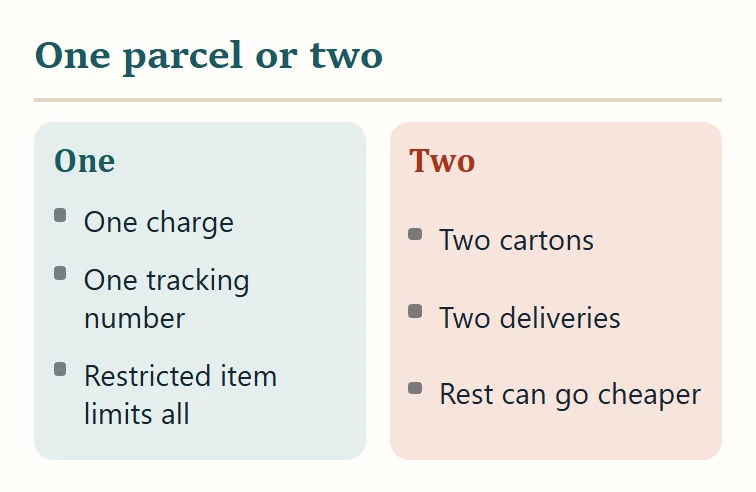
Combining is normally cheaper, but not always. Lines set maximum weights and sizes, and prices often step up at fixed weights, so a parcel just over a step can cost more than two smaller ones. A single restricted item can also hold the whole parcel to an expensive line.
Splitting has its own costs: two outer cartons, two tracking numbers, possibly two rounds of import paperwork and two delivery attempts. Run both versions through the planner and compare the estimates side by side before deciding. If the saving is small, one parcel is less to keep track of.