
Two payments in yuan, weeks apart
Buying through an agent splits the bill in two, weeks apart, in a currency that is not yours. This page puts the parts in order so you can predict the total before the first payment rather than discover it at the second.
Money in two instalments
The first payment happens when you order. It covers the item price for the option you chose and the seller’s delivery to the warehouse inside China. CNFans listed a help article called Service & Fees, but its content was never captured, so we cannot say whether a service charge sits on top. Check the order summary before you confirm.
The second payment happens when the parcel is ready to leave. It covers the international line for the chargeable weight, any packing or photo extras you asked for, and any optional cover.
Between the two sits time. Budget for the second payment on the day you make the first, using the box planner for a rough weight, so you are not tempted to choose a poor line later just because the money ran short.
The second bill, itemised
The line price is usually the largest part, calculated from the chargeable weight: the greater of real weight and bulk-based weight. Some lines add fuel or remote-area surcharges. Packing extras, such as extra padding, a stronger carton or vacuum bags, are charged by some agents and not others.
Optional cover against loss or damage may be offered as a percentage of the stated value of the contents or as a flat fee. Read what it actually pays out for, and what proof it asks for, before you buy it.
Finally, your own country may charge import duty, tax and a handling fee when the parcel arrives. Those go to the local carrier and your government, not to the agent, and they are not in any estimate you see in China.
Catalogue prices in yuan, your money in something else
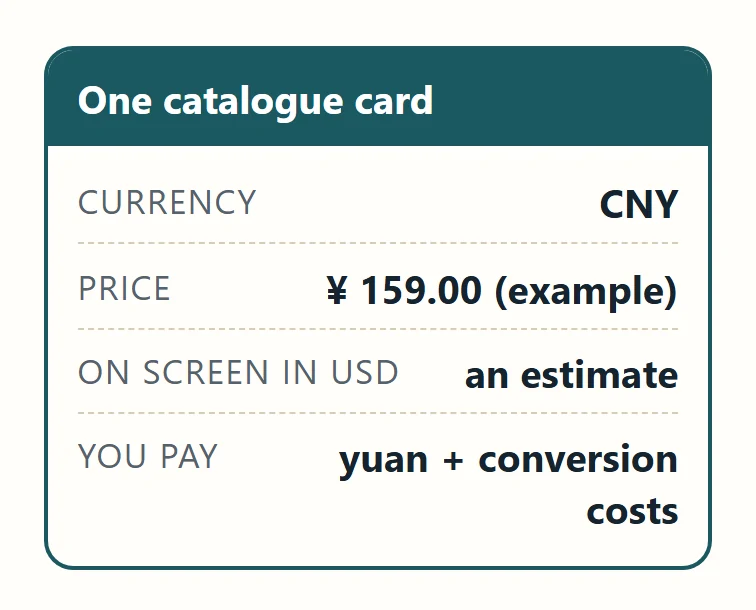
Catalogue prices are listed in Chinese yuan, the currency sellers set them in. When we pulled racks on 20 October 2026, every listing the catalogue returned carried the currency code CNY. Sellers in China are paid in yuan whatever you see on screen.
In the archived CNFans header from 23 August 2026, a currency menu showing USD sat next to the language menu, and the help centre listed Top up and International Credit Card under Payment, with Visa and Mastercard logos in the footer. A converted figure on screen is a convenience; the real price is the yuan figure plus whatever conversion happens on the way.
Exchange rates: three conversions that can stack up
A purchase in yuan paid from euros, pounds or dollars can be converted in up to three places. The display conversion on a website is only an estimate. The agent applies its own rate when you top up or pay, which may include a margin. Your card issuer may convert again and add a foreign transaction fee if the charge is processed in another currency.
To calculate an effective rate, compare the yuan amount actually purchased with the payment-currency amount charged for that same transaction. Record service and payment fees separately where shown. A difference from a reference rate can include fees and timing as well as conversion margin; it is not automatically a pure exchange-rate charge.
We do not publish an exchange rate here: any figure would have gone stale before you read it.
Keeping a running total for each parcel
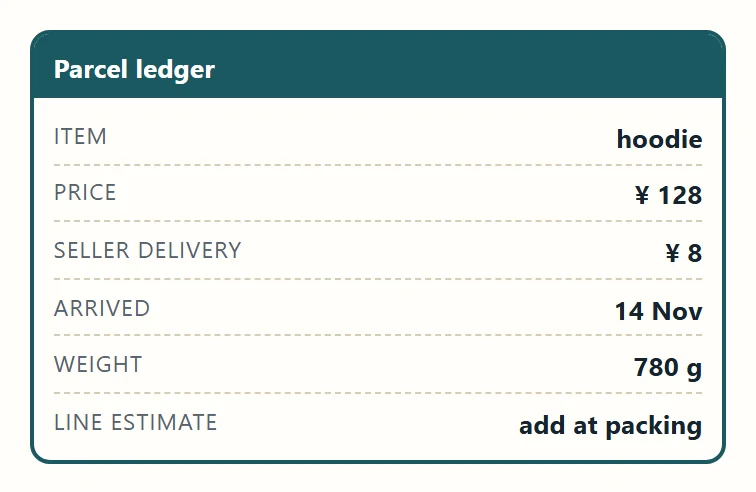
A small record kept per parcel turns the second payment from a guess into arithmetic. For each item note the yuan price, the seller’s domestic delivery, the date it reached the warehouse and the weight recorded there. Add the planner’s chargeable weight and the estimate for the line you expect to use.
When the parcel ships, add the real line price and, on arrival, any import charges. After two or three parcels you will know your own typical cost per kilogram to your door, which is worth more than any average quoted online.
Numbers missing here on purpose
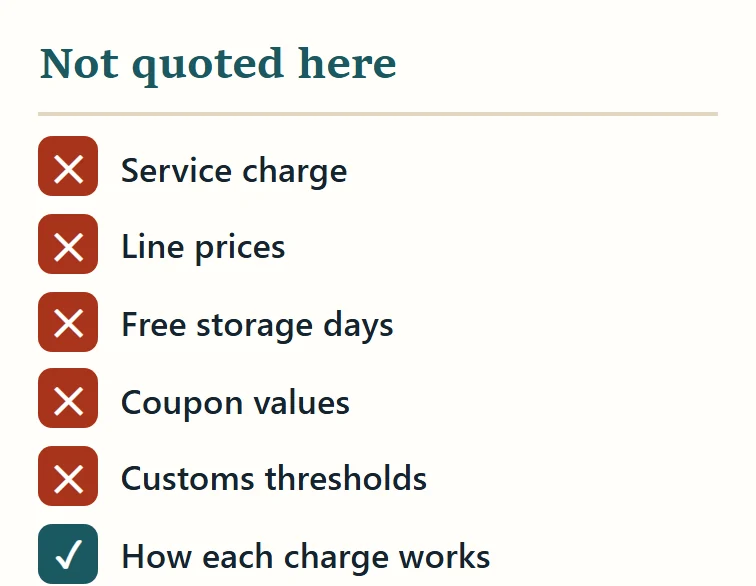
You will not find service charge percentages, line prices, free storage days, coupon values or customs thresholds for CNFans on this site. Some were never published in a form we could capture; others change too often to print responsibly; one, the length of free storage, is printed differently in each of the three sources we hold, and in one of them not at all.
Instead we describe how each charge is calculated and where to find the current number. When cnfans.com is serving pages again, the order summary and the estimate for your own parcel are the only figures worth trusting.
Compare two packing quotes without mistaking weight for money
Take an illustrative 3.2 kg parcel. In a 50 × 40 × 30 cm carton, a divisor of 6,000 gives 10 kg dimensional weight. In a 40 × 30 × 20 cm carton it gives 4 kg. Those figures compare billable-weight candidates; they are not prices and do not prove that the second quote costs 60% less.
A line may have a minimum charge, rounding increments, a different divisor or weight-only pricing. Request quotes for the same destination and contents, and compare the displayed total together with tracking, accepted contents and compensation terms. A cheaper line that refuses an item is not an alternative.
Before authorising repacking, ask whether it has a fee and what happens to discarded packaging. If an item may still be returned, settle that request before removing packaging the seller requires. Keep the original quote, the accepted revised quote and the final charge together.