The warehouse look: your last chance to stop a find from travelling
When an item reaches the agent’s warehouse in China it is photographed for you. Those photos are the only inspection you get before it crosses a border. Here is how to use them well.
What a warehouse quality check is for
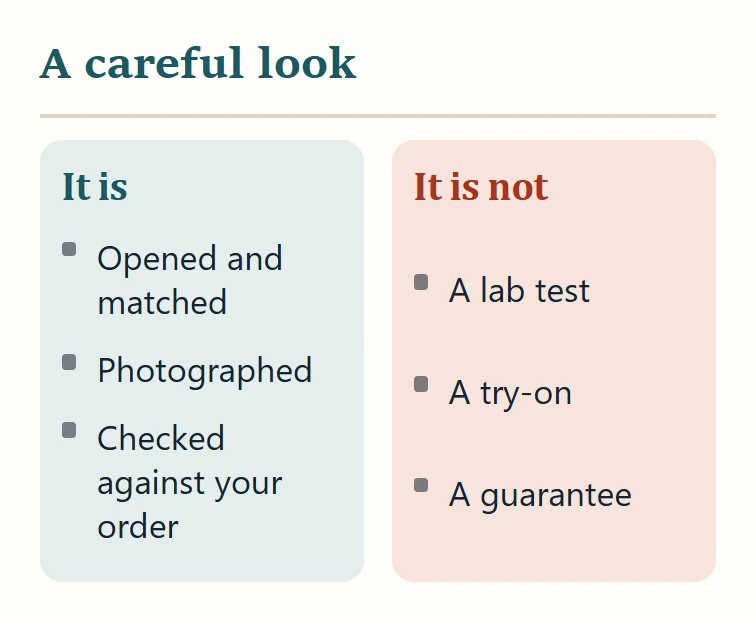
QC, short for quality check, is the step where warehouse staff open the seller’s parcel, confirm it matches your order and photograph what arrived. It is not a laboratory test and nobody tries the item on. It is a careful look by someone who has your order details in front of them.
For a buyer abroad the value is timing. The photos arrive while the item is still a domestic delivery away from the seller, so an exchange or refund is realistic. Once the parcel has flown, sending something back to China costs more than most items are worth.
Read the photos the day they appear, not the day you plan to ship. Sellers are more helpful about a problem raised quickly.
Five passes through the warehouse photos
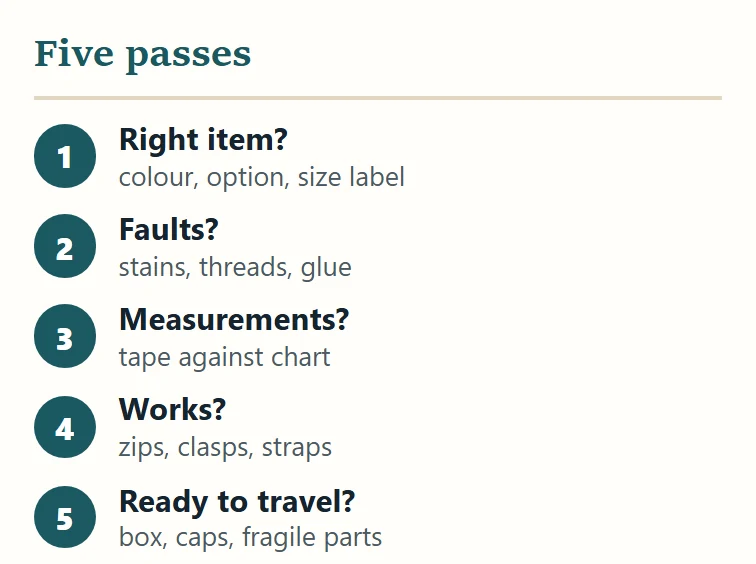
One: is it the right thing? Compare colour, option and size label with your order, not with your memory of the listing. Two: is anything wrong with it? Look for stains, pulled threads, glue marks, uneven stitching and damaged hardware, zooming into the seams.
Three: do the measurements match? If a tape measure is in the photo, compare it with the seller’s chart. Four: does everything work? Zips, buttons, clasps and straps should look complete and aligned.
Five: is it ready to travel? This pass is the one buyers abroad skip, and the next section is about it.
Photos that matter for the trip home
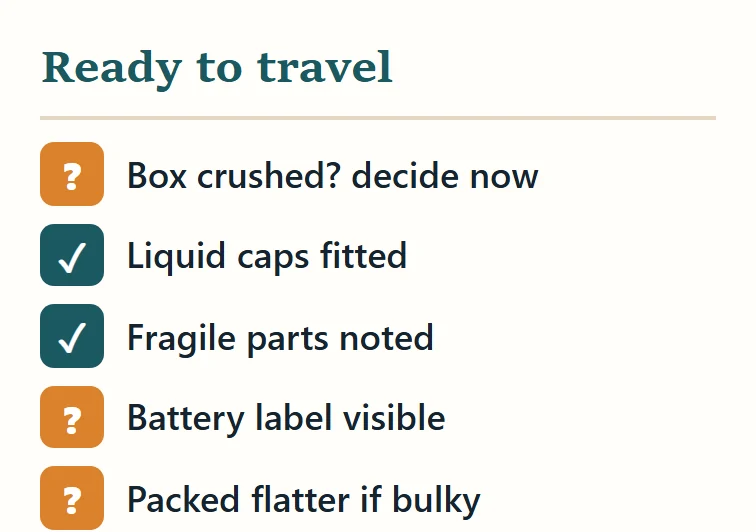
Look at the packaging as well as the product. A crushed shoebox in the photo will not improve after a flight; decide now whether it travels or stays. Check that anything liquid has its cap fitted and is not weeping into its box. Note fragile parts, such as the arms of glasses or the peak of a cap, so you can ask for extra padding.
If an item carries a battery, look for its label or packaging in the photos; you may need it to choose a line that accepts it. And look at the size of what arrived. A jacket that came folded in a large box is a sign to ask for flatter packing before you plan the parcel.
Asking for more: measurements, angles, a weight
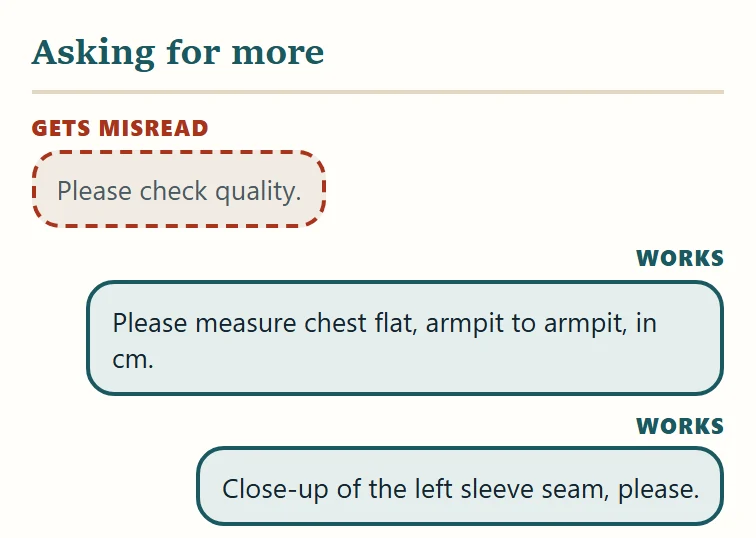
If the standard photos leave a doubt, ask for something specific: a flat measurement of the chest or the inside leg, a close-up of a seam, a photo of a label, or the item’s weight on its own. Specific requests get specific answers. “Please check quality” gets the same photos again.
Before requesting an extra photo or measurement, check whether it is included and what a chargeable request costs. Specify the angle or endpoints that would change your decision; a vague request for “better QC” does not identify the missing evidence.
Returns are realistic only on the Chinese side
If the photos show the wrong item or a real fault, raise it with the agent straight away and ask what the seller offers: an exchange, a refund, or a partial refund if you decide to keep it. Return postage inside China is usually modest compared with any international journey, and some sellers cover it when they made the mistake.
Be fair about what counts as a fault. A colour that looks slightly different under warehouse lights is normal; a different colour is not. Sellers on Chinese marketplaces often set their own return windows, so the clock may already be running when the photos arrive.
Keep your photos after the parcel ships
Save the warehouse photos to your own device before the parcel leaves. If something arrives damaged or different, they show what the item looked like at the warehouse, which matters when you ask the line or the agent about a claim.
Photograph the parcel yourself when it arrives, before opening, and again as you unpack. With a before and an after, a problem becomes a conversation about evidence rather than memory.
A folder per parcel, named with the date it shipped, is enough. Put the warehouse photos, the estimate you accepted and every tracking number in it, and keep it until the window for a claim on that parcel has passed.
A jacket photo cannot tell you the box size
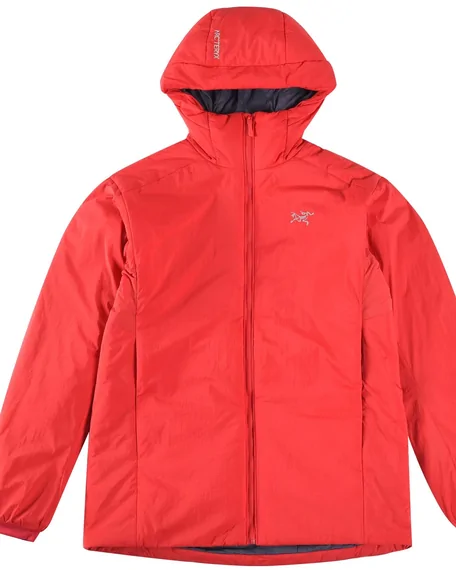
The red jacket below has a hood and a full-length front zip. It is displayed flat against white, which helps identify the style and colour. It does not show thickness, packed dimensions or the condition of an item received for an order.
- Identity: compare the ordered colour, hood and zip layout with the arrival photo.
- Condition: request a close view of a damaged or unclear area; the seller’s clean cover cannot rule out a fault on your piece.
- Travel: obtain packed dimensions after the proposed packaging changes. A flat garment and a padded carton occupy different amounts of space.
For example, ask “What are the packed dimensions with the current packaging, and what would change if the removable outer box is omitted?” Only compare options the warehouse actually offers. Keep protection for parts that can be crushed; the smallest box is not always the best one.