The Landfall box planner for CNFans parcels heading abroad
Type the weight of each item, the packing and the box size you expect. The planner shows what a line is likely to charge for and which item is responsible. It runs in your browser, saves nothing and sends nothing anywhere.
Plan the box
Each line of the form below is one item. Use the weight recorded at the warehouse if you have it, otherwise your best estimate. The example figures are there to show how it works; replace them with yours.
| Item | Weight each (g) | How many | Remove |
|---|---|---|---|
Type your own weights and box size; the results update as you go.

Where the numbers you type should come from
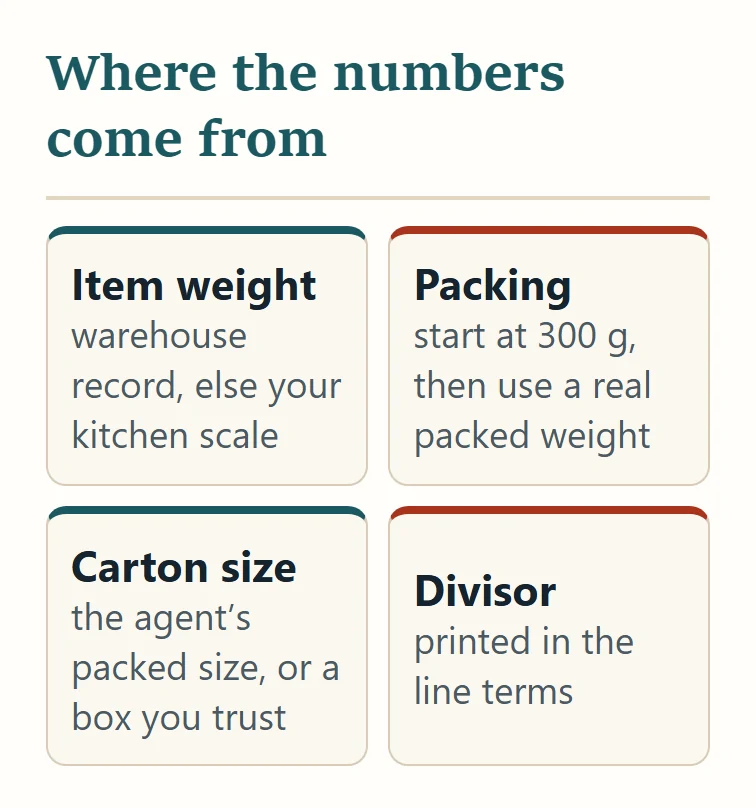
Item weights. The best figure is the one the warehouse records when an item arrives, because it includes the seller’s bag, tags and any box. Before that, the next best is your own kitchen scale: weigh a similar garment you already own. A thick hoodie you have at home tells you more than a guess.
Packing. Agents add an outer carton and padding when they pack a parcel. We have no CNFans figure for this, so the planner starts at 300 g as a placeholder you should change once you see a real packed weight.
Box size and divisor. Use the size the agent quotes after packing, or a box you think everything fits in. The divisor is printed on each line’s terms; couriers commonly publish 5,000 or 6,000 cubic centimetres per kilogram. The field starts at 6,000; change it to whatever the line you are looking at prints.
Reading the four results
Actual weight is every item multiplied by its quantity, plus packing. Bulk-based weight multiplies the carton’s three sides in centimetres and divides the result by the divisor. Most international lines charge for whichever of the two is larger, and that is the third figure, the line will charge.
The fourth, bulk against scale, compares the two. Below 1.0 the parcel is dense and the scale decides; trimming packaging will not help much, but leaving out the heaviest item will. Well above 1.0 the box is mostly air or padding, and a smaller carton, a box left behind or a jacket folded tighter will save more than removing a T-shirt.
The sentence under the results names the item that adds the most weight, so you can see the cost of one decision.
Invented numbers, worked through
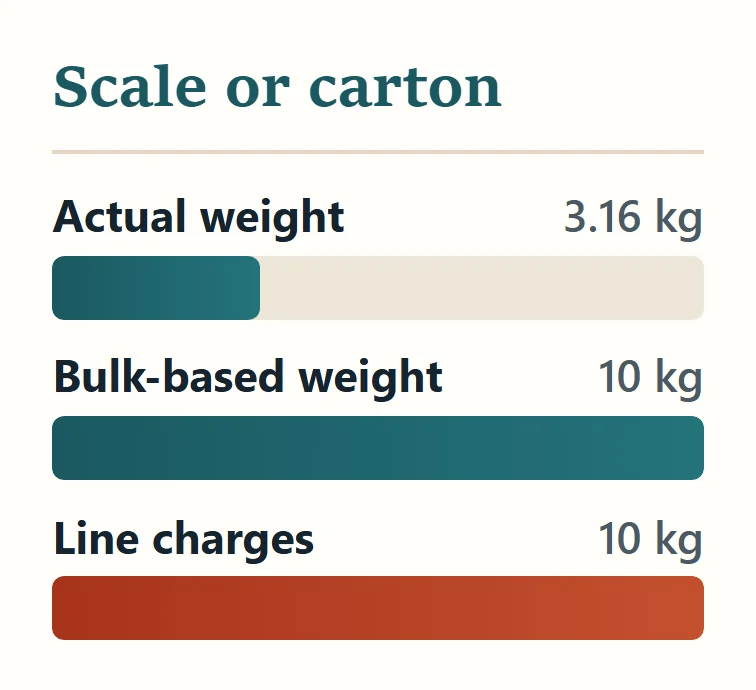
These figures are invented for the arithmetic, not taken from any line. Say a padded jacket weighs 1,100 g, trainers in their box 1,400 g and two T-shirts 180 g each, with 300 g of packing. The actual weight is 3,160 g.
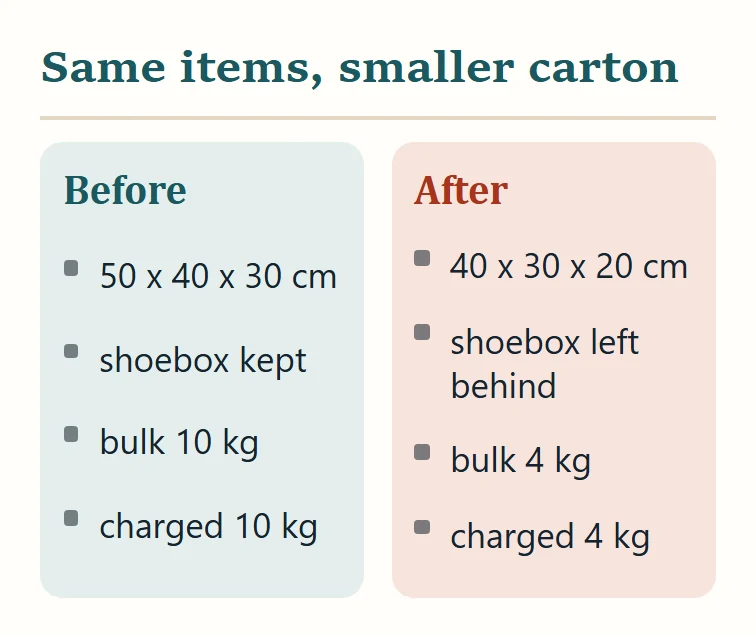
Packed into a 50 by 40 by 30 cm carton with a divisor of 6,000, the bulk-based weight is 10 kg. The line charges for 10 kg even though the scale says just over 3. Leave the shoebox behind, fold the jacket into a 40 by 30 by 20 cm carton, and the bulk-based figure falls to 4 kg. The chargeable weight falls from 10 kg to 4 kg without removing a single item; the price still depends on the line's tariff.
That is the lesson the planner exists to teach: for clothing parcels, the carton is often the real price.
What the planner cannot know
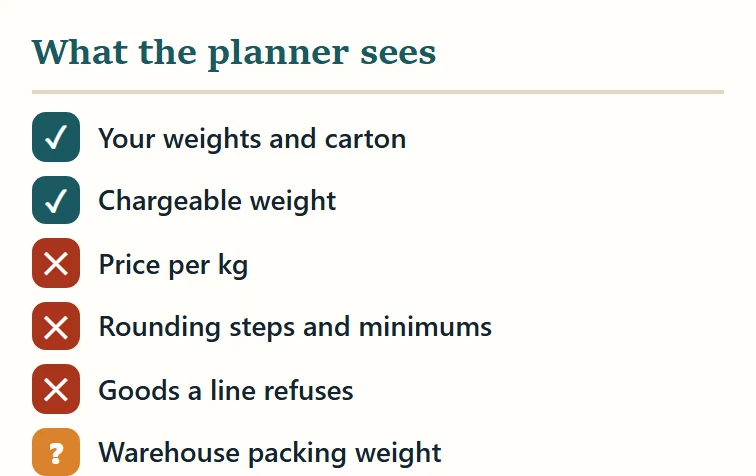
It does not know your line’s price per kilogram, its minimum charge, the weight steps it rounds up to, or its surcharges for remote areas or fuel. It does not know whether a line refuses batteries or liquids, or the largest parcel it accepts. Those details live on the estimate you see when you choose a line.
It also cannot weigh what the warehouse adds. If the packed weight on your order page differs from your total, trust the order page and adjust the packing figure here so your next plan starts closer to reality.
Search box, racks and China clock
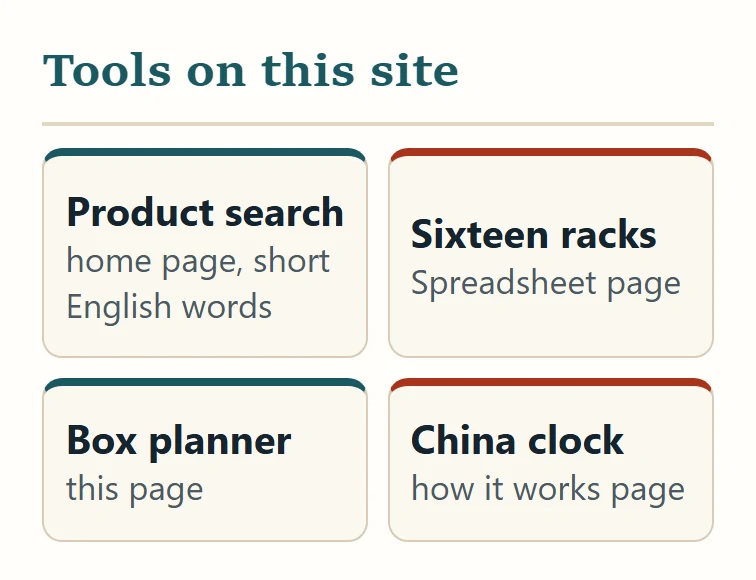
The search box on the home page searches the whole product catalogue. The way to use the search box: type short English product words; try linen shirt or rain jacket.
The racks on the Spreadsheet page open each category directly, each card carrying a one-line packing tip. The box planner above works as a weight-only shipping estimator. The China clock on the how it works page shows the time in China next to yours, so you know when a message is likely to be read.
None of these tools asks for an account, stores what you type or sets cookies. Close the tab and it is gone.